Sooner or later, something in your house is going to break.
It won’t wait until you finish language school.
Early on in Brazil, buying things at the store and getting things fixed around the house gave me plenty of reasons to use Portuguese. They also gave me plenty of opportunities to discover words I didn’t know.
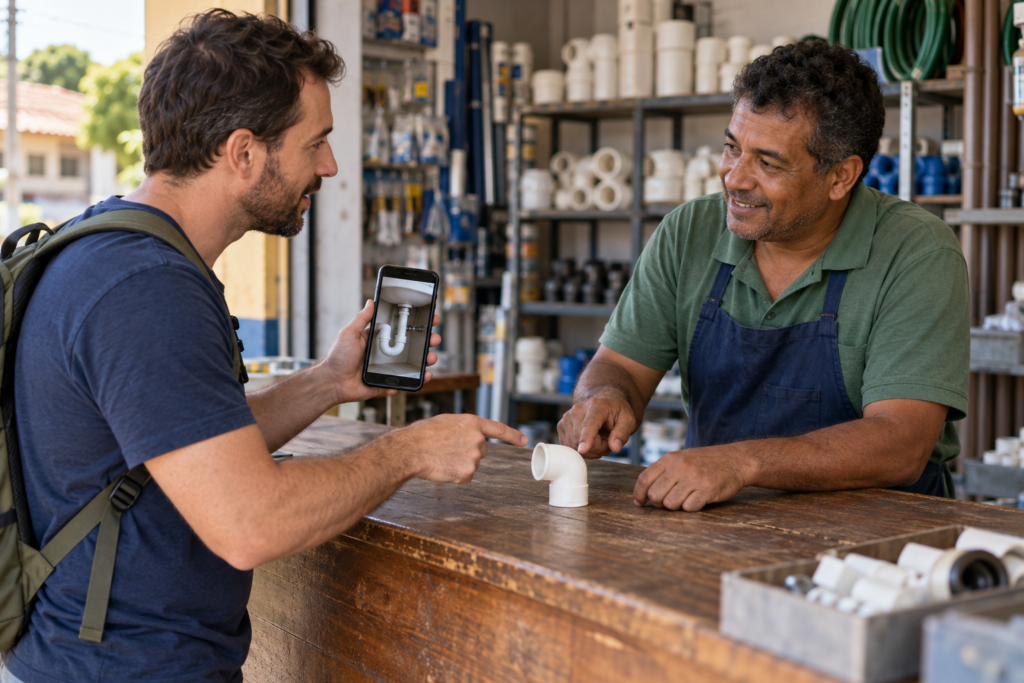
One time, I went into a store and showed a picture of what I needed. Another time, I used Google Translate to ask for a part. The translation wasn’t very accurate, but eventually the person figured out what I meant.
Some advice I received helped me in situations like that: when you don’t know the word, keep trying. Explain the thing a piece at a time.
What does it do? Where does it go? What does it look like?
I came to appreciate how much of the learning happens in that effort.
Work with the words you have
It’s easy to reach a missing word and feel like you’ve reached the end of the conversation.
You know what you want in English. You don’t know what it’s called in Portuguese. Now what?
Try another way.
Suppose you need a part for a sink. You might be able to explain:
“It goes under the sink.”
“Water comes out here.”
“This part is broken.”
Those are examples, but the point is practical: you may know enough language to help someone understand, even when you don’t know the exact name.
You can describe its size, shape, location, or purpose. You can point, gesture, or show a picture while you talk.
Give the other person something to work with.
Let the conversation take some effort
When I was trying to explain what I needed, I had to reach for words I knew. I had to listen to the other person’s questions. Sometimes I needed to try a different explanation.
That took work.
But the effort was valuable. I was using Portuguese to accomplish something that mattered to me right then. I needed a part. I needed to solve a problem. There was a reason to understand and be understood.
That’s what I mean when I say there is beauty in the trying.
You don’t have to wait until you can give a polished explanation. A rough explanation can get a conversation started, and the other person can help you from there.
Use a picture to start the conversation
Showing a picture helped me.
It gave us something we could both look at while we worked out what I meant. A translation app was another tool I tried, although it didn’t always give me the wording I needed.
Use the help available to you, then stay involved in the conversation.
Once the person understands, ask what they call the item. Listen to how they say it. Try saying it back.
You came in needing something from the store. You can leave with that item and a little more language than you had before.
Write down what you learn
I kept a notebook with me everywhere I went.
When someone said something useful, I could write it down. If I didn’t understand an expression, most of the time I would ask what it meant.
That habit fits naturally into situations like these.
After someone helps you find the part, write down its name. Better yet, add a short phrase that shows how you would ask for it again. Include enough about the situation that the note will make sense when you look at it later.
Then revisit it.
A word connected to a problem you actually worked through gives you something concrete to remember.
Measure the small successes
For a missionary arriving in Brazil, “learn Portuguese” is a necessary goal. It is also a very large one.
Everyday life gives you smaller goals to work on:
- Find something you need at the store.
- Explain what is broken.
- Ask whether someone can fix it.
- Find out when they can come.
- Ask them to explain something again.
Some of those conversations will require help. That’s fine.
Notice what you managed to do. Maybe you couldn’t follow every word, but you explained the problem. Maybe you needed a picture, but you understood the question the person asked afterward.
Those moments give you specific things to practice and reasons to keep going.
Give people a chance to understand you
You will run into words you don’t know. You will forget words you thought you knew. Sometimes a translation on your phone will leave both of you puzzled.
Keep trying.
Describe what you can. Ask questions. Listen to the answer. Let the other person help you find the missing pieces.
The conversation may take longer than you wanted, but you’re getting practice you couldn’t get by waiting until you felt ready.
You don’t have to know every word to begin.
Sometimes you just need to explain where the thing goes—and what happens when it breaks.
Related reading: You Can Learn the Language. Start Now. Browse more language-learning resources for missionaries.